
Find Better Trades
Your 10 Step Checklist

Most traders start in the wrong place. They look for the stock already moving, the one already breaking out, the one already getting attention on social media, financial TV, or the top-gainers list.
That feels exciting, but excitement is usually where discipline starts breaking down. By the time everyone sees the move, the clean entry may already be gone. Risk may be wider. The stock may be closer to resistance than support. And instead of trading from a plan, the trader is now chasing because they do not want to miss out.
That is not a process. That is emotion wearing a trading hat.
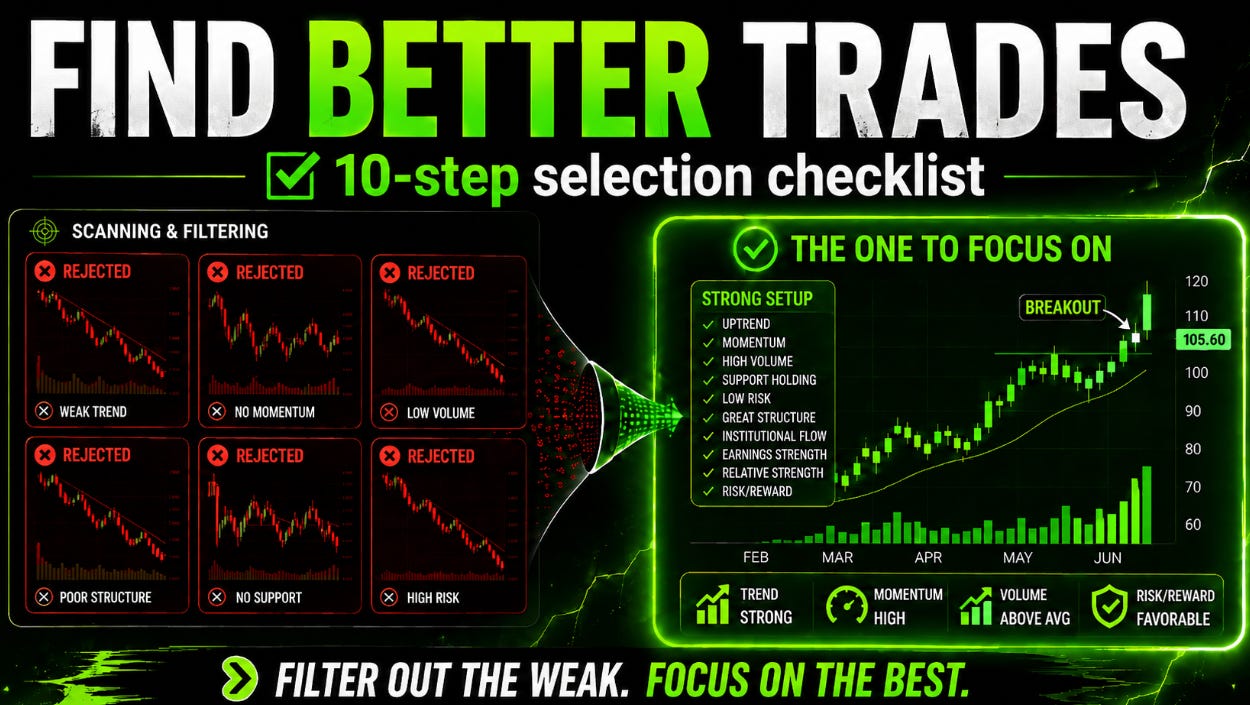
The better question is not, “What stock is moving today?” The better question is, “What stock is building the kind of structure that could lead to the next move?”
That shift changes everything.
Good stock selection is not about predicting the future. It is about filtering out weak setups and focusing only on stocks where the trend, support, momentum, catalyst, and risk all line up. You are not looking for perfect trades. Perfect trades do not exist.
You are looking for better trades. Trades where you know why you are entering. Trades where you know where you are wrong. Trades where the potential reward makes sense compared to the risk. Trades where you are not buying because the chart looks exciting, but because the setup gives you a reason.
That is how you find stocks with real profit potential.
Step 1: Start With Strength
The first mistake many traders make is trying to catch broken stocks at the bottom. They see a stock down 50%, 60%, or 70%, and they assume it must be cheap.
But cheap is not a setup.
A stock can be down a lot and still have further to fall. A broken trend can stay broken for months. A stock that looks low can drift lower while your capital is tied up in a trade that never had real strength behind it.
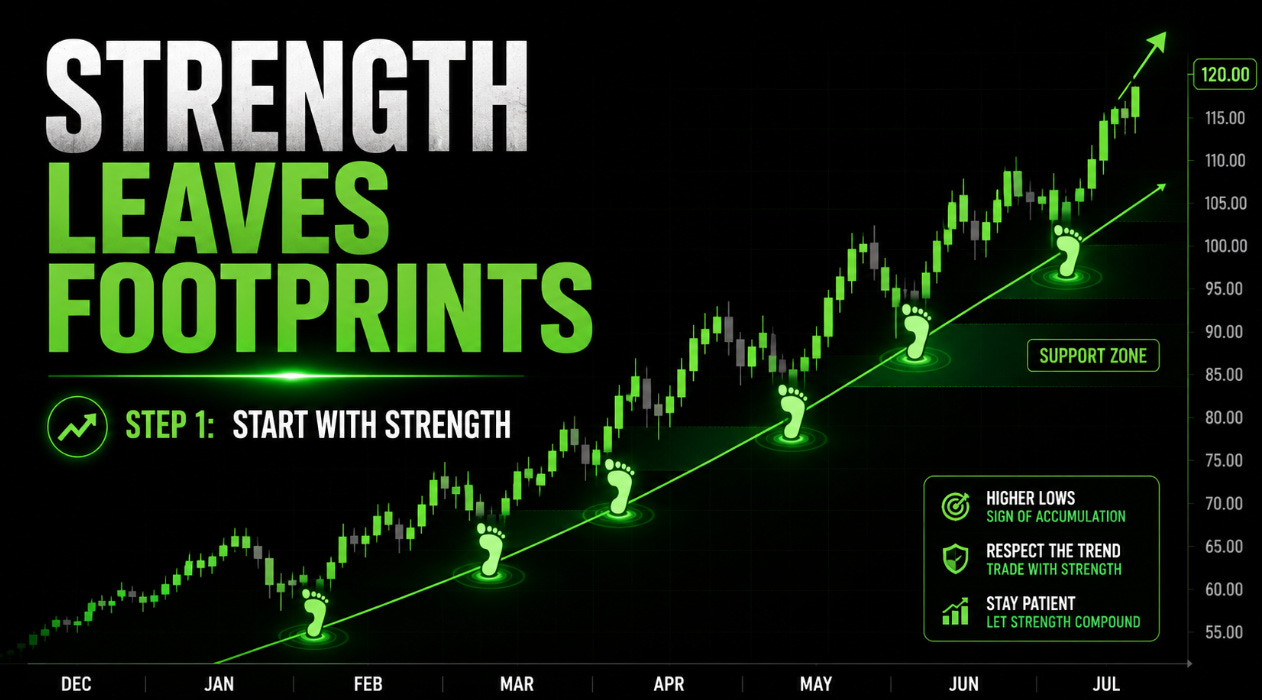
The better place to start is with stocks already showing signs of demand. That does not mean chasing vertical moves. It means looking for stocks that are holding up better than the market, building higher lows, reclaiming important moving averages, consolidating near highs, or pulling back in a controlled way instead of falling apart.
Strong stocks leave clues. They recover faster than weak stocks. They hold support better. They pull back less aggressively. They often move sideways while weaker names are breaking down.
That is where the search begins. You want stocks where buyers are already present. You want charts where the stock is not asking you to believe in a miracle. You want setups where strength is already showing up before the breakout becomes obvious.
Strength comes first.
Step 2: Make Sure the Trend Is Clear
Once a stock shows strength, the next question is simple: is there a real trend?
A clean trend does not need to be complicated. You are looking for a stock that is making higher highs and higher lows, holding above important support, and moving in a direction that is easy to identify.
If you have to stare at the chart for twenty minutes trying to decide whether it is bullish, it probably is not clean enough.
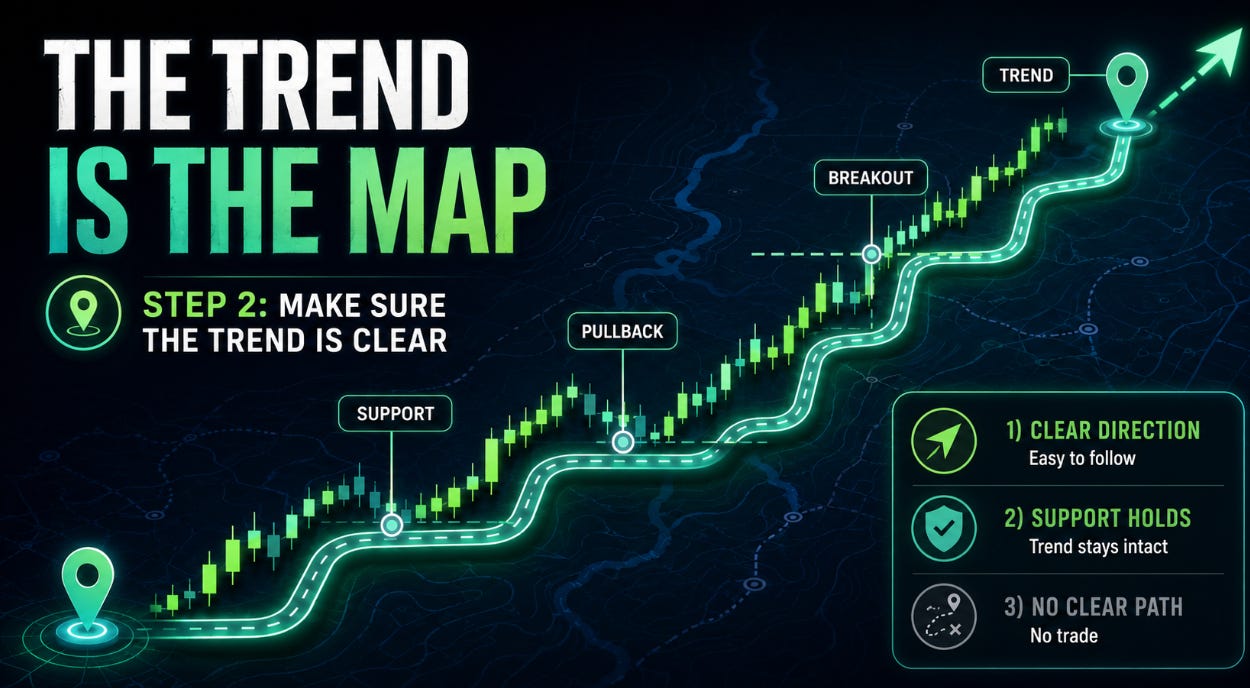
Clean trends make decisions easier. Price should be moving from the lower left of the chart toward the upper right. Pullbacks should look controlled. Buyers should continue stepping in before the chart breaks down. Support should matter. Resistance should be clear.
This is where traders get into trouble. They force setups on messy charts because they want action. But messy charts create messy decisions.
If the stock is chopping sideways with no clear trend, no clear support, and no clear resistance, move on. There will always be another trade.
A stock does not need to be perfect, but it should have direction.
Step 3: Mark the Support Zone
Support is where the trade starts to become measurable. Not because support guarantees the stock will bounce. It does not. Support matters because it helps define risk.
If a stock has been trending higher and repeatedly holding a certain area, that level becomes important. It shows where buyers have stepped in before. It gives you a place to watch. It also gives you a clear warning sign if the setup starts to fail.
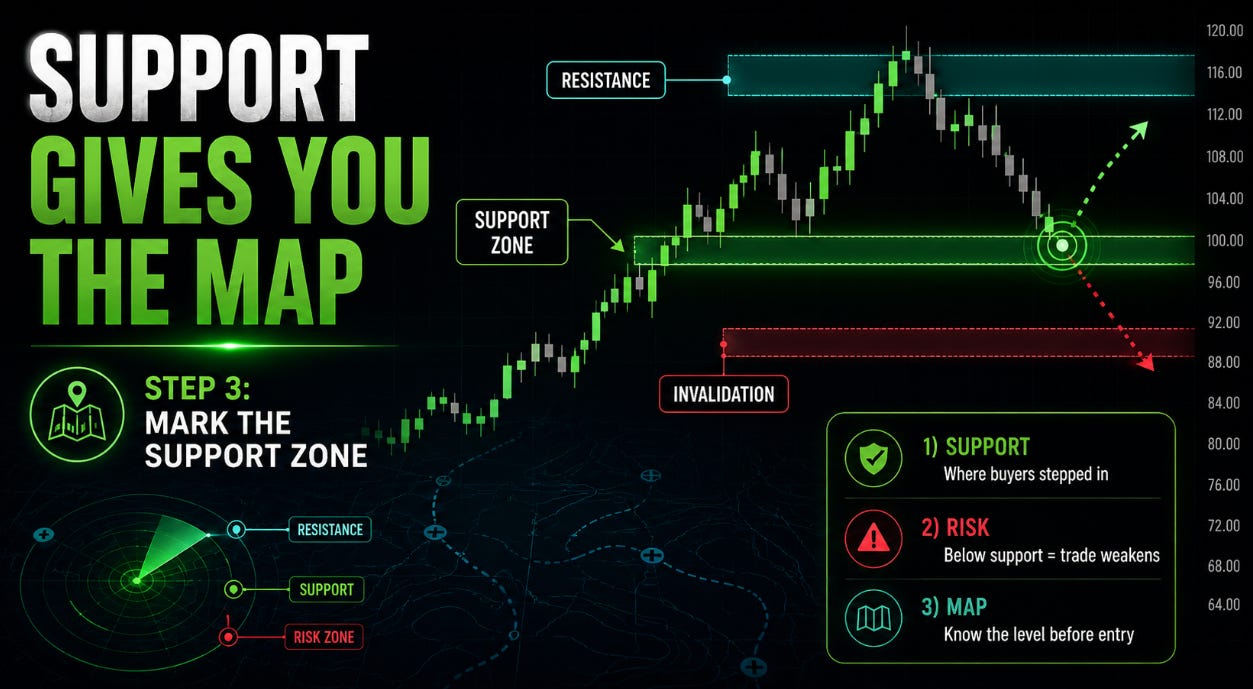
This is one of the biggest differences between disciplined trading and emotional trading. Emotional traders enter because they like the stock. Disciplined traders enter because the chart gives them a level.
For example, if a stock is trading around $75 and support sits near $70, now you have structure. You can say, “If price pulls back into $70 and holds, the setup remains constructive. If it breaks below that area, the trade starts to weaken.”
That is far better than buying randomly and hoping.
Support is not magic. Support is your map. Without support, you do not know where risk begins. And if you do not know where risk begins, you do not really have a trade. You have an opinion.
Step 4: Identify Resistance
After support, you need to know where resistance sits. Resistance is the area where sellers have shown up before. It could be a prior high, a failed breakout level, or the top of a consolidation range.
This level matters because it tells you where the next expansion move may begin.
A lot of traders buy directly into resistance without realizing it. They see a stock moving higher, get excited, and enter right as price reaches the area where sellers have been waiting. Then the stock stalls. Then it pulls back. Then they wonder what happened.
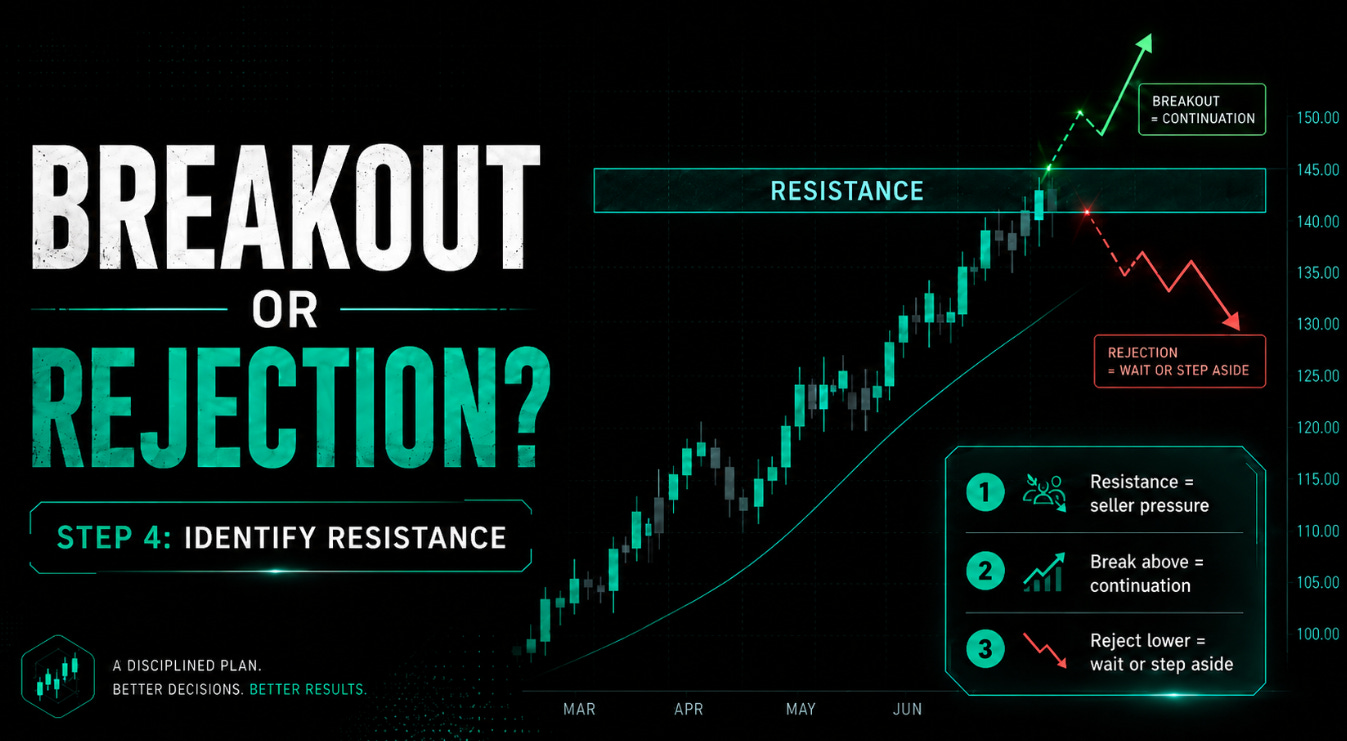
That is not bad luck. That is poor positioning.
The cleaner trade is usually one of two things: buy near support if the stock stabilizes, or wait for a confirmed breakout above resistance. Support gives you better risk. Breakouts give you confirmation.
Both can work, but they are different trades, and you need to know which one you are taking.
The mistake is mixing them together. Traders buy too far above support, too close to resistance, and then get trapped in the worst possible location.
Know your level before you enter.
Step 5: Check Momentum
Momentum tells you whether the stock still has energy behind the move. You do not need ten indicators. You do not need to make this complicated.
A simple RSI reading can help. If RSI is holding above 50, the stock is usually still in a constructive momentum zone. If RSI is pushing into the 60s, momentum is improving. If RSI is extremely extended, you may need patience and wait for a reset.
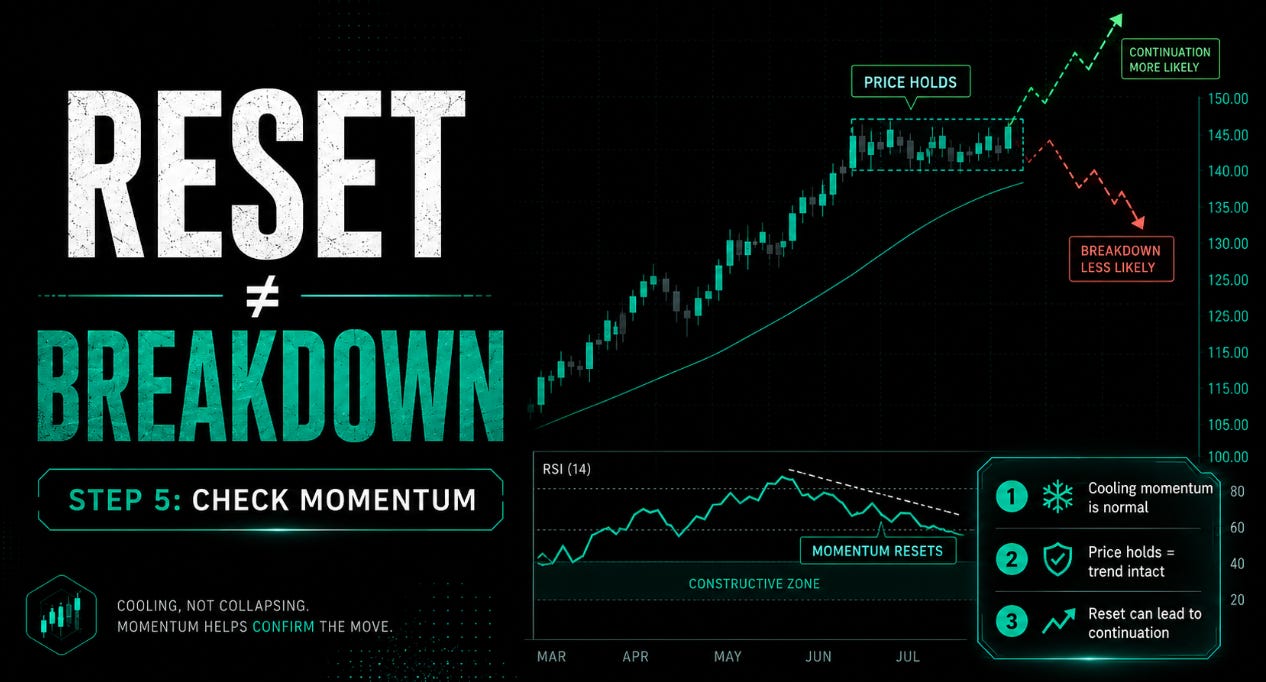
The best setups often happen when momentum cools without price breaking down. That distinction matters.
Weak stocks lose momentum and collapse. Strong stocks lose momentum and go sideways.
That sideways action frustrates impatient traders, but it often creates opportunity. Price tightens. Support holds. Sellers fail to take control. Momentum resets. Then the stock has room to expand again.
You are not looking for a stock that is screaming higher every day. You are looking for a stock that still has constructive momentum while giving you a reasonable entry.
That is a much better setup.
Step 6: Look for a Catalyst
A good chart becomes stronger when there is a reason behind it. That reason is the catalyst.
A catalyst could be earnings growth, a sector trend, a product launch, improving margins, analyst attention, commodity strength, institutional buying, government spending, AI demand, biotech data, defense contracts, housing demand, or any other factor that gives buyers a reason to keep showing interest.
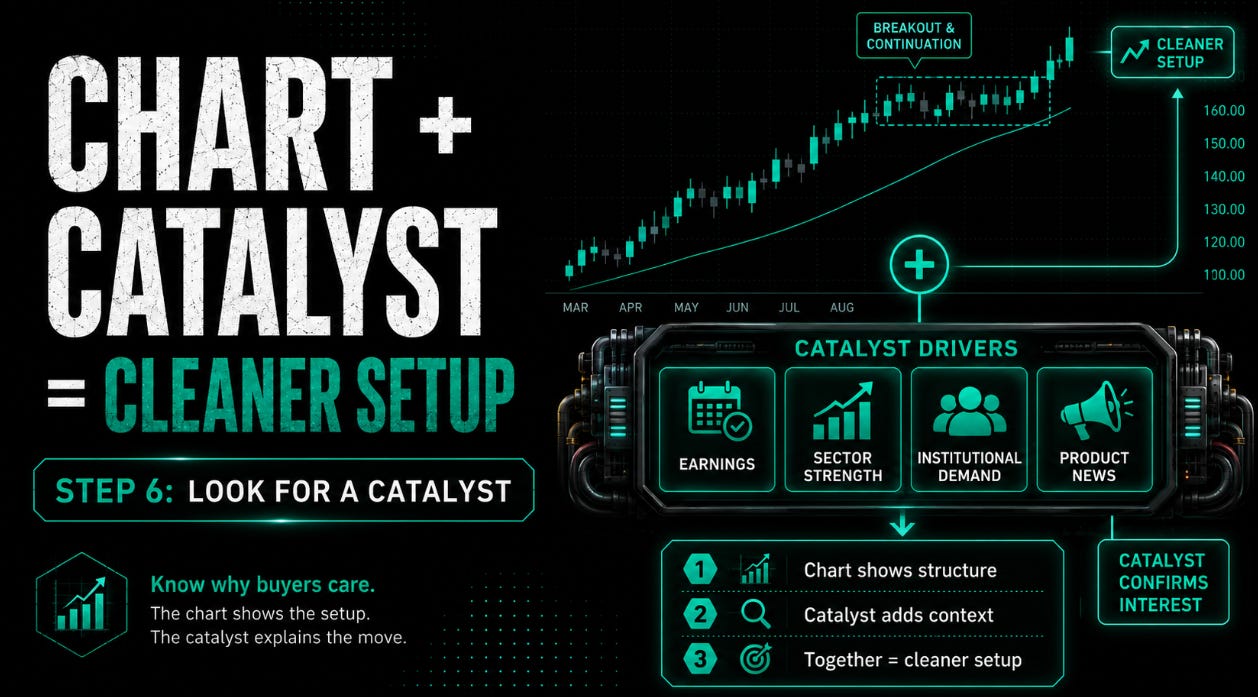
The catalyst does not guarantee the trade works. Nothing does. But it gives the move context.
This matters because you do not want to buy a stock just because the candles look good. You want to understand why the market may care.
A chart tells you what is happening. A catalyst helps explain why it may continue. The strongest setups usually have both.
Strong structure plus a real catalyst is much better than a random chart with no story behind it.
That does not mean you need to become a fundamental analyst on every stock. But you should at least know why the stock is moving, why buyers may continue showing up, and whether the catalyst supports the chart.
When structure and catalyst agree, the setup becomes cleaner.
Step 7: Define Where the Trade Is Wrong
This is where traders either become disciplined or become gamblers. Before you enter a trade, you need to know where the setup fails. Not after the stock drops. Before.
If you cannot define where you are wrong, you do not have a trade. You have a hope.
The invalidation level should be based on structure. It might be below support, below a higher low, below a key moving average, or below the level that would clearly change the trend.
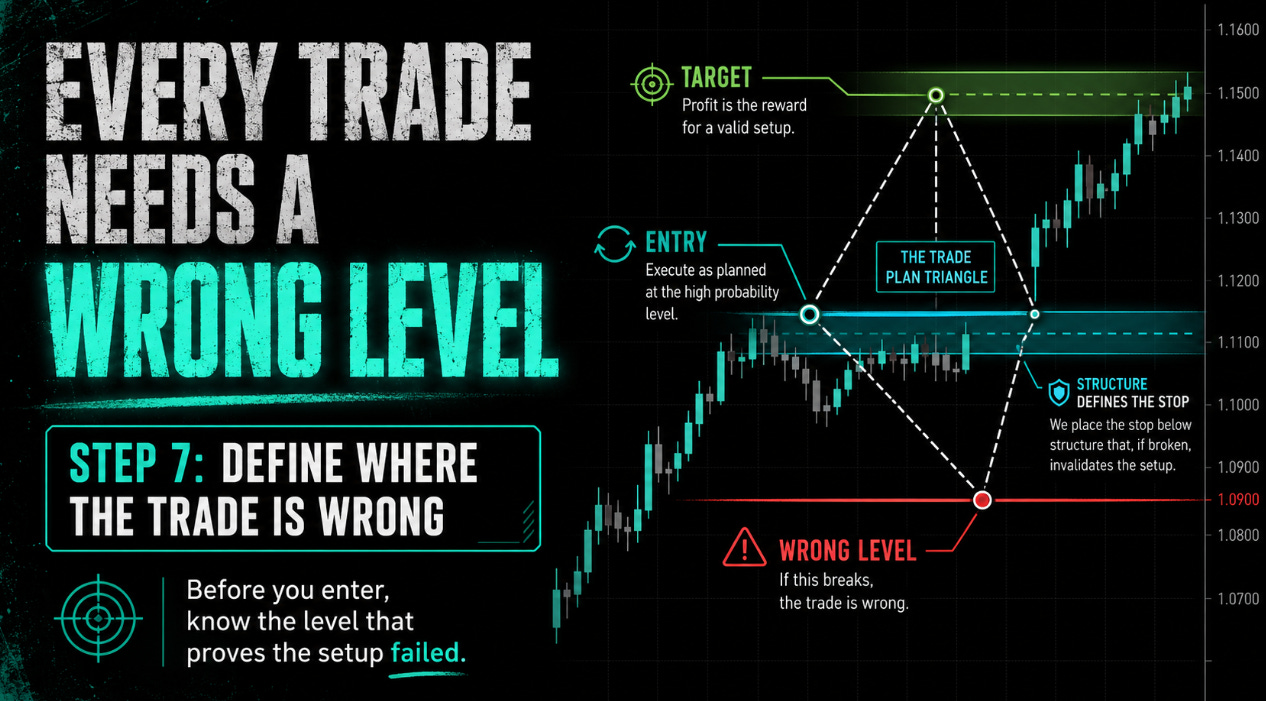
The level has to mean something.
You are not randomly picking a stop because you do not want to lose more than a certain amount. You are choosing a level where the chart proves the original trade idea is no longer valid.
That gives you clarity. If the level holds, the trade remains alive. If the level breaks, you exit or adjust. No drama. No panic. No emotional debate. The decision was already made.
That is the power of structure. It removes the argument from the trade.
Step 8: Make Sure the Reward Is Worth the Risk
A stock can have a good chart and still be a bad trade. That usually happens when the entry is poor.
If a stock is sitting right below resistance and far above support, the risk may be too wide. You may be risking $10 to make $5. That does not make sense.
A better setup gives you room to profit while keeping risk controlled.

Before entering, ask where support is, where resistance is, where the target is, where the invalidation level is, and whether the upside justifies the downside. If the answer is no, skip it.
This is hard because traders hate skipping trades. They feel like skipping means missing out. But skipping bad risk/reward setups is one of the most profitable habits you can build.
You do not need every trade. You need the right trades.
A great-looking stock at a bad entry can still become a bad trade. The goal is not just finding strong stocks. The goal is finding strong stocks at levels where the risk makes sense.
That is the difference.
Step 9: Build a Watchlist Before You Trade
Most bad trades happen because traders react in real time. They see a candle move. They feel urgency. They jump in.
That is backwards.
The better process is to build a watchlist before the market forces a decision. Your watchlist should include stocks that already passed your filters: clear trend, defined support, defined resistance, constructive momentum, real catalyst, clear invalidation, and reasonable reward compared to risk.
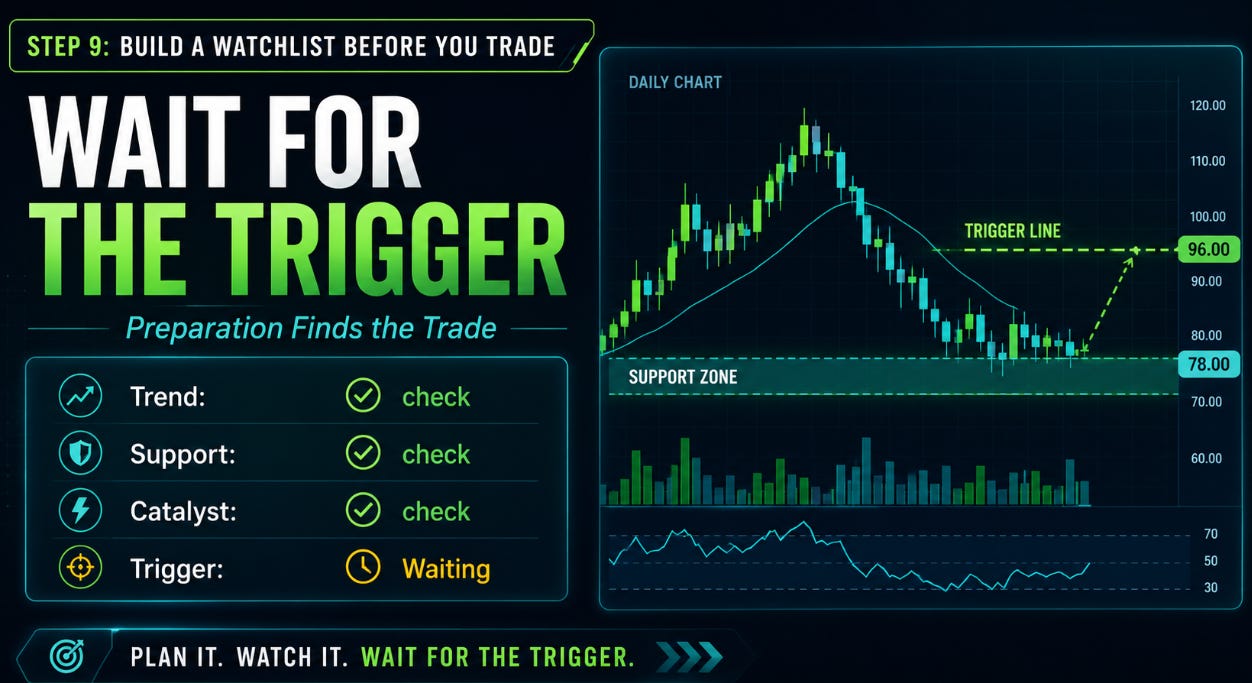
Once a stock makes the watchlist, you are not blindly buying it. You are waiting for the trigger.
That trigger could be a pullback into support. It could be a breakout above resistance. It could be a higher low forming. It could be a volatility spike that creates better premium for an options trade.
The watchlist gives you preparation. The trigger gives you execution. That combination keeps you from chasing.
Most traders do not need more ideas. They need fewer, better ideas with clear rules attached to them.
That is what a good watchlist does.
Step 10: Execute the Plan, Not the Emotion
Finding a good stock is only half the job. The other half is managing yourself.
A clean setup can still turn into a bad trade if you chase, oversize, ignore the stop, move the target, or panic because of one red candle.
That is why the plan matters.
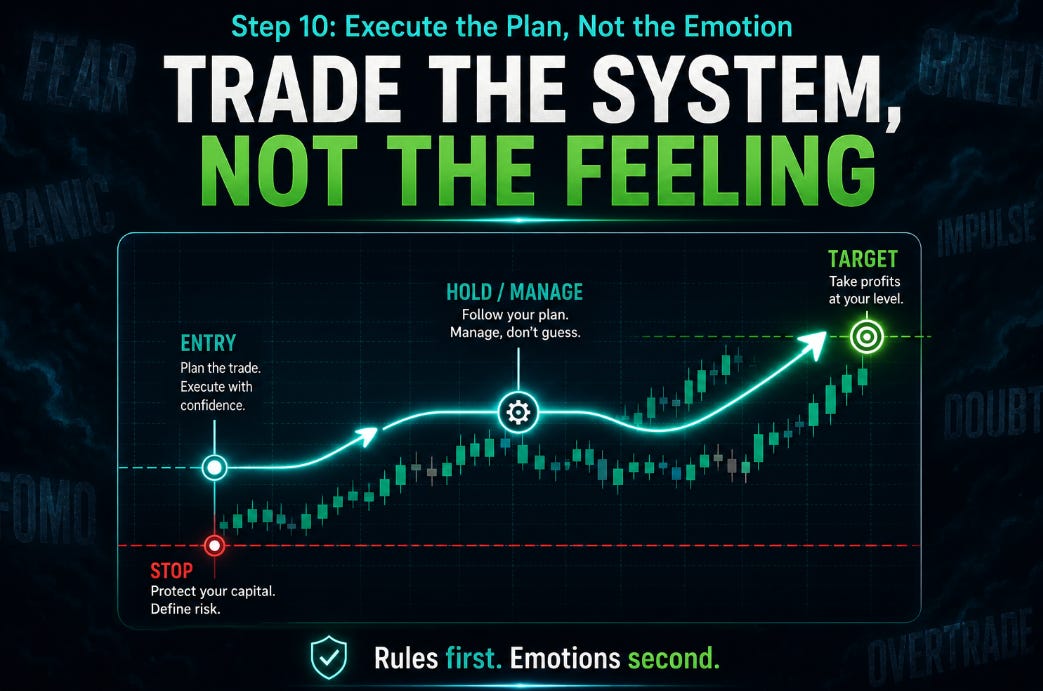
Before entering, know the entry, target, risk level, position size, and exit plan. If the trade works, take the profit according to the plan. If the trade fails, take the loss according to the plan. If nothing happens, be patient.
Most traders do not lose because they cannot find stocks. They lose because they cannot follow a process after they find them.
They turn every trade into a personal test. It is not personal. It is just structure.
One trade does not define you. One winner does not make you a genius. One loser does not mean the system failed. What matters is whether you keep making clean decisions over time.
That is where consistency comes from.
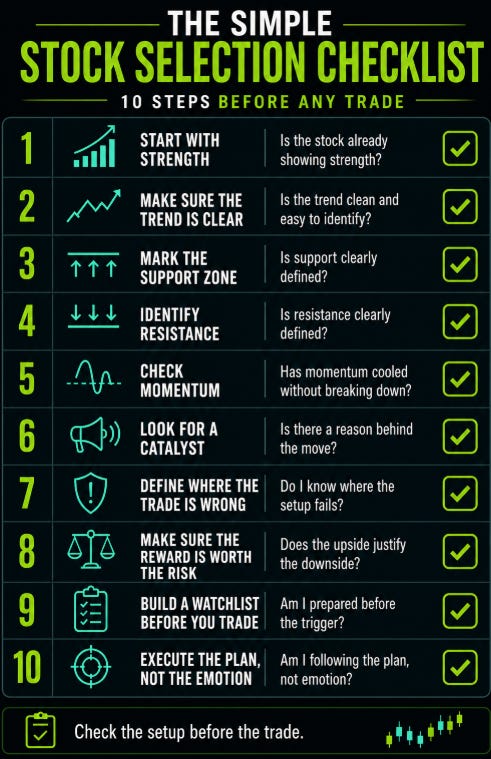
The Simple Stock Selection Checklist
Before putting a stock on your watchlist, ask these questions:
Is the stock already showing relative strength?
Is the trend clear?
Are higher lows forming?
Is support easy to define?
Is resistance easy to identify?
Has momentum reset without breaking?
Is there a catalyst behind the move?
Do I know where the setup fails?
Does the reward justify the risk?
Do I have a clear entry trigger?
If the stock does not pass most of these filters, it probably does not belong on your list. That does not mean it cannot go higher. It means it does not fit the process.
And the process is what protects you from random decisions.
Final Takeaway
Good stock selection is not about finding the perfect trade. It is about removing the bad ones.
The weak charts. The messy trends. The extended breakouts. The stocks with no clear support. The trades where you have no idea where you are wrong.
Once you eliminate those, the better setups become easier to see.
Stocks with real profit potential usually leave clues before the move becomes obvious. They hold support. They build higher lows. They consolidate instead of collapse. They reset momentum without breaking trend. They give you a level, a trigger, and a reason to act.
That is what you are looking for.
Not hype. Not hope. Not whatever ticker is trending today.
Just structure, confirmation, and disciplined execution.
Because markets do not reward the trader who chases the most. They reward the trader who prepares the best.
Casey Stubbs
Freedom Income Options
Replace Your Paycheck, Reclaim Your Freedom